Reblogged from Sonoma Magazine. Original Article found here.
By Jennifer Graue (November 2026)
Cameron Woodruff is a problem solver, and he’s doing it with pie. A piano technician who rebuilds Steinway concert grand pianos, Woodruff has taken on a second identity as a baker and entrepreneur, compelled by what he saw as a need for something — anything — to help the local apple industry at a critical moment, particularly the celebrated Gravenstein apple.
“Everyone has this sentiment of not wanting to see them disappear,” he says of the heirloom variety. “The most fundamental aspect is demand.” So Woodruff set out to create it. A year ago, the 42-year-old Forestville resident launched The Gentle Hearth and began selling pies, mustard, and barbecue sauce made with Gravenstein apples at the beginning of 2026.
He works out of commercial kitchens in Sebastopol, including one on a rural property south of town. The drive takes you past Apple Blossom Elementary School, Appleseed Lane, and barns and houses adorned with botanical imagery, leaving little doubt you’re in apple country — or at least what remains of it.
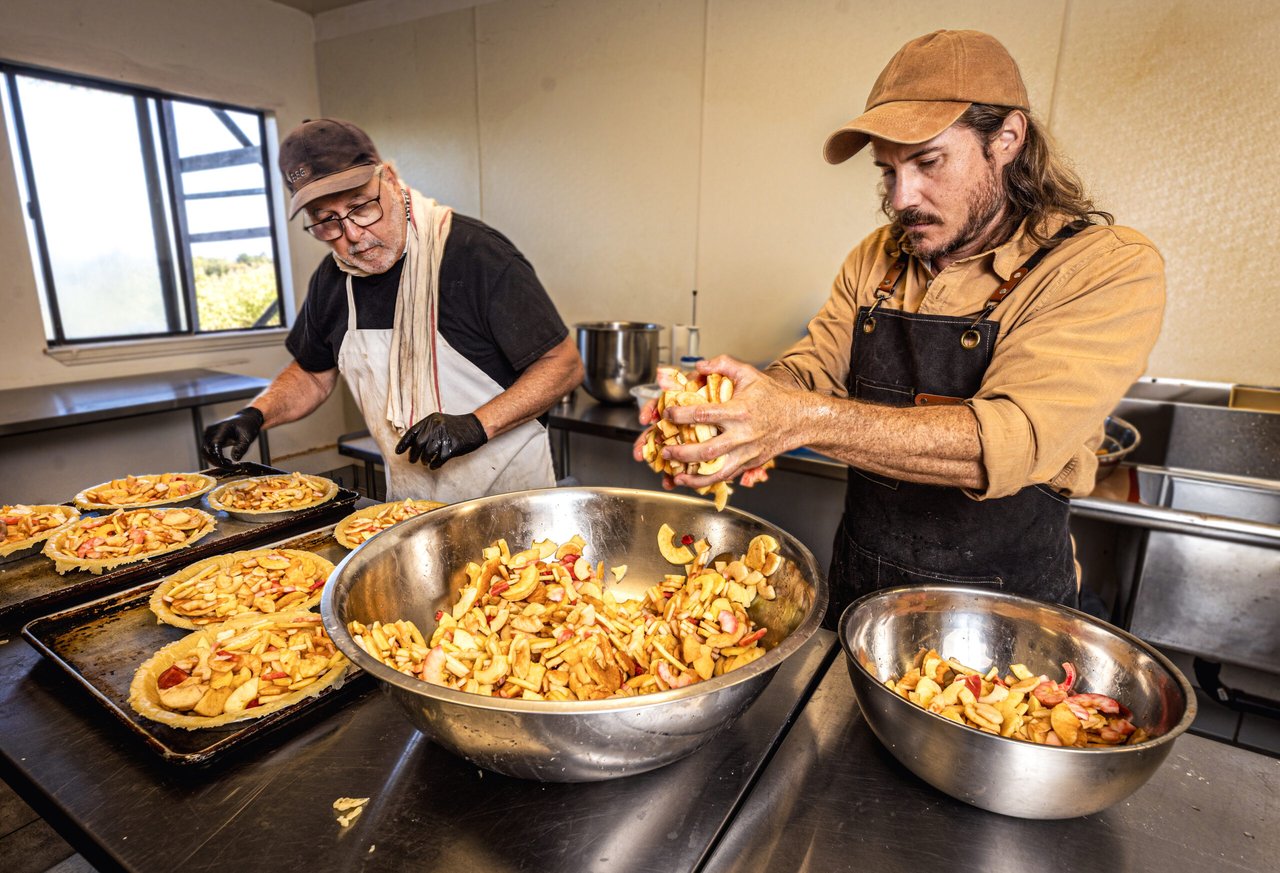
One Friday afternoon, the aroma of freshly baked pastry and cinnamon drifted through the autumn air, an olfactory compass pointing the way toward Woodruff and his small kitchen crew as they peeled and sliced Gravenstein apples for 24 pies he would take to the farmers markets over the weekend.
It was a modest, manageable batch compared with the 300 pies he baked for the 2026 Gravenstein Apple Fair, an undertaking that pushed the small commercial kitchens where he works to their limits. But if anyone can find a way to make the most of the limited capacity, it’s Woodruff.
The pie recipe belonged to his grandmother. Growing up in Marin County, Woodruff often spent idyllic weekends visiting his grandparents, Gene and Marilyn Malm, in Occidental. Their home had a small orchard, and Marilyn’s Gravenstein pies were the highlight of family gatherings. When Woodruff created The Gentle Hearth, he drew on those memories. “I wanted to do something to capture these feelings I was fortunate enough to have on my grandparents’ property and to bring that joy to others,” he says.
One of the first people to recognize the promise of his pies was Peter Bettendorff, a baker who makes a wildly popular gluten-free almond cake sold at Sebastopol Cookie Company. Bettendorff has since become a member of his kitchen crew.
The distinguishing feature of Woodruff’s pies is their olive oil crust. The filling is comparatively straightforward: sugar, cinnamon, a few spices he declines to disclose, and local apples — naturally. “The recipe is secondary,” explains Woodruff. “If the apples are delicious, you’re going to have a great pie.”
Sonoma County apples are largely dry-farmed, a practice that produces crisp, firm, and intensely flavorful fruit. Supermarket apples shipped in from elsewhere are no substitute. FEED Cooperative, a local food hub that works with dozens of farms, says the average grocery store apple is 14 months old, with flavor and nutritional value diminishing with each passing day.
That dependence on local fruit means Woodruff’s pie season has an expiration date. He freezes some apples to extend production, but when that supply runs out, he won’t turn to grocery store apples to keep the ovens going. Instead, he uses Gravensteins in pantry products: a barbecue sauce made with smoked apple syrup, applesauce and apple cider vinegar, and a mustard made with apple syrup, apple cider vinegar, and avocado oil infused with frozen peels left over from pie making. The peels lend another layer of apple flavor while helping to reduce waste. Woodruff is developing other products, too, including sauerkraut made with cabbage and apple peels.
A student working toward a civil engineering degree at Santa Rosa Junior College, Woodruff is constantly refining recipes and processes, looking for ways to improve quality and efficiency. Before investing in a pie press he found in Canada, he built a prototype. To speed up the tedious task of dotting pie filling with cubes of butter, he found another solution: a three-holed sauce dispenser that squirts softened butter over the filling before adding the top crust.
These are relatively small, solvable problems. The challenges facing the local apple industry are considerably larger.
Orchard acreage has dwindled to about 2,000 acres in 2024, down from 14,000 during the Gravenstein’s heyday. Now the county faces the impending departure of Manzana Products Co., its last remaining processing plant, which is scheduled to end operations and move to Washington by next year.
Woodruff is under no illusion that one pie business can reverse decades of decline. But he believes it can help. “You’ve got to start somewhere,” he says. “I can do my part and I hopefully will inspire others. Within a year, I’m making really good headway.”
His ambitions extend beyond his current operation. In the coming year, he hopes to work out of a new apple processing plant in Santa Rosa purchased earlier this year by Brooke Hazen, the owner of Gold Ridge Organic Farms in Sebastopol. Woodruff says the facility has a walk-in oven capable of baking 240 pies at a time — an exponential leap from where he’s at now. Still, even thousands of pies may not be enough to restore the industry.
Carole Flaherty, a member of Slow Food Russian River and coordinator of the Save Our Orchards project, has spent years confronting the problem. At 80, she continues to tend 200 apple trees of her own. One priority, she says, is persuading more grocery stores to stock local apples, either instead of or alongside fruit trucked in from Washington or elsewhere. Another is finding people willing to maintain the orchards, particularly the backyard plots that have long been part of the region’s agricultural landscape. “These guys are aging out, and we don’t see anybody in the wings to take it on,” says Flaherty.
Her concern is unmistakable. But the efforts of Woodruff and others, including Gold Ridge Organic Farms, Little Apple Treats, and local cideries, offer reason for optimism.
For Woodruff, the immediate challenge is Thanksgiving. He needs to establish a system for taking holiday orders and determine where customers can pick up their pies. Beyond that lies a more complicated question: the Gravenstein apple cider vinegar and applesauce he uses in his products are made by Manzana. When the company leaves for Washington, his local source for those ingredients disappears with it. But that’s a problem for another day. “I’ll figure it out as I go,” he says.
For now, Woodruff is content to play a small part in addressing a problem with no easy answers. Every pie he sells creates another reason to grow, harvest, and preserve the Gravenstein. In an industry struggling to find its footing, that counts for something.